We use cookies to make your experience better. For more information, see our Privacy Policy page. If you're happy with this, please click the Accept button.

Modern Slavery Statement
Introduction
Our Modern Slavery statement is published by Thread 35 Limited t/a Sosandar (“Sosandar”) in accordance with the requirements set out in the Modern Slavery Act 2015 which covers the financial year ending 31 March 2025 where turnover reached £37.1m.
We continue to be completely opposed to slavery in all its forms, and we are pleased to outline the steps and activities Sosandar is currently taking to prevent modern slavery across our business and supply chain, along with our commitments for 2025 – 2026, which we have set out in further detail below.
As an expanding business, with a growing national and international presence, we understand the risk that modern slavery poses and its existence. This is mainly due to the complex, sometimes disconnected, and not so transparent, supply chains making up some of the fashion industry. This document outlines the steps undertaken to ensure that modern slavery of any guise is not present within our operations in adherence to the Modern Slavery Act 2015.
About Sosandar and our supply chain
Sosandar was founded in 2016 by two multi award winning female entrepreneurs, Ali Hall, and Julie Lavington, who between them have over 40 plus years’ experience in Fashion and Media. The Company continues to be one of the fastest growing fashion brands in the UK (Drapers, April 2024).
September 2024 saw us open our first standalone store with further openings across the UK, the brand is now trading as a full price multichannel retailer, with all our key stakeholders and supply chain partners operating under the fundamental principles around modern slavery.
We understand that our business has an impact on the world around us and we are dedicated to ensuring that impact remains positive. Throughout the design and manufacturing of all our merchandise, Sosandar has a deep commitment to responsible practices, and we are dedicated to working with suppliers who share our belief in operating responsibly and with a high level of integrity.
Our journey to sourcing product more sustainably is ongoing as we look to continuously enhance our operations. Our leather is sourced from Leather Working Group accredited tanneries, our denim is produced in a way that minimises water usage and we have increased the use of responsibly sourced and recycled fibres in our ranges. We continue to utilise consumer packaging, including ‘green PE’ polythene bags, which are fully recyclable and carbon negative. All our garment labelling is produced using recycled fibres, however, we recognise that there is always more to do and our commitment to reducing the impact we have on the environment is a key priority over the coming years.
Our sourcing strategy is fully focused on building key, long-term partnerships around the globe with our products now manufactured through 52 suppliers across 112 T1 facilities in 13 countries, including China, Turkey, India and several EU countries. This is an increase year on year driven by our strategy to elevate our product and adapt to an omnichannel buying model supporting the brands multichannel offer. To underpin this, we have rolled out a comprehensive, detailed update to our Supplier Handbook and accompanied Business Policies to ensure best practices across our supply chain and products that are internationally compliant with all relevant legislation.
To guarantee our high standards are maintained, we regularly conduct comprehensive assessments of ethical, sustainable and manufacturing practices throughout our supply chain. Our Sourcing, Compliance and Technical teams oversee this process to safeguard the consistent upholding of our ‘Code of Conduct’ and relevant business policies at every level of our operation.
Due Diligence
At Sosandar, we implement a comprehensive due diligence approach to evaluate, monitor, and mitigate potential business risks and prevent human rights violations. Recognising that human rights protection is crucial and continuously evolving, we have established policies, processes, and standards to closely oversee our supply chain and ensure compliance with relevant regulations and industry best practices.
Code of Conduct
We use this code to outline the minimum requirements that all product suppliers must uphold in relation to their workers such as employment being freely chosen, no harsh or inhumane treatment of workers, and ensuring that child labour is not used. This code is aligned to the Ethical Trading Initiative (ETI) Base Code, which is founded on the conventions of the International Labour Organisation (ILO) and is an internationally recognised code of labour practice. The code is contained in our supplier onboarding portfolio.
We require all suppliers to sign a declaration confirming that each of their manufacturing facilities and/or third-party subcontractors producing goods does so in accordance with the ETI base code and local law, which must be returned to us before production commences. It is a term of our contract that suppliers must not use or permit the use of child labour or unethical manufacturing processes.
Supplier Terms and Conditions and Policies
All suppliers are contractually bound by the terms and conditions set out in our onboarding process which includes key ethical policies. These cover areas such as anti-slavery, human trafficking, anti-bribery, and whistleblowing.
Further fundamental policies relating to modern slavery are communicated to our suppliers and throughout our business covering areas such as:
- Cotton fibre sourcing
- Environmental chemical policy
- Animal welfare standards
- Prohibited or restricted sources
- Sourcing in high-risk areas and
- REACH compliance
Risk Assessment, Prevention and Mitigation
Risk assessment is crucial to our strategies and decision-making regarding suppliers, sourcing, and overall business operations. We consider various factors when evaluating risks, such as the country and region of origin, supplier setup and ethical practices, and applicable local and international legislation.
We reserve the right in our terms of business to audit/visit all factories either directly or through a nominated third party. Such audits include, but are not limited to, a review of universal rights in accordance with the UN Guiding Principles; responsible recruitment; entitlement to work, immigration; sub-contracting and homeworking.
Our suppliers are only permitted to use production facilities and/or third-party subcontractors that we have approved in advance.
Our approach is to give clear guidance on expectations with our supply base promoting full transparency at both onboarding stage and through ongoing supplier communications.
To increase our visibility and understand our supply chain, we have fully mapped our Tier 1 production sites and champion in person factory visits by our Sourcing, Compliance and Product teams. We have processes and systems in place to continue mapping our supply base beyond our direct Tier 1 factories to enhance the visibility of our supply chain and ensure compliance with our processes and requirements. Regular visits to all main production territories give us the opportunity to discuss sustainable and ethical working conditions face to face, as well as give us first hand visibility and knowledge of better practices.
When and if problems are discovered, we work with suppliers to ensure the best outcome for all concerned parties.
Third Party Audits
We annually request audits from our Tier 1 and Tier 2 manufacturing sites within Sosandar’s supply chain to ensure our high standards are met, alongside other key documents, including:
- A Full Audit report from independent and internationally recognised companies such as SMETA (Sedex Members Ethical Trade Audit) or BSCI (Business Social Compliance Initiative) ensuring our global supply chain complies with expected standards.
- Completed and signed supplier forms including the Sosandar Terms of Business.
- Completed factory set-up forms.
The audits assess a variety of subjects such as working conditions, hours worked and wages. The Sourcing and Compliance team at Sosandar review each audit thoroughly. If a non-compliance is highlighted, we work with suppliers to ensure they are resolved and closed off with the relevant audit body. Whilst we recognise the benefits of this process, we are committed to work alongside our supply base rather than against them, to embed a system of continuous improvement that goes beyond audits.
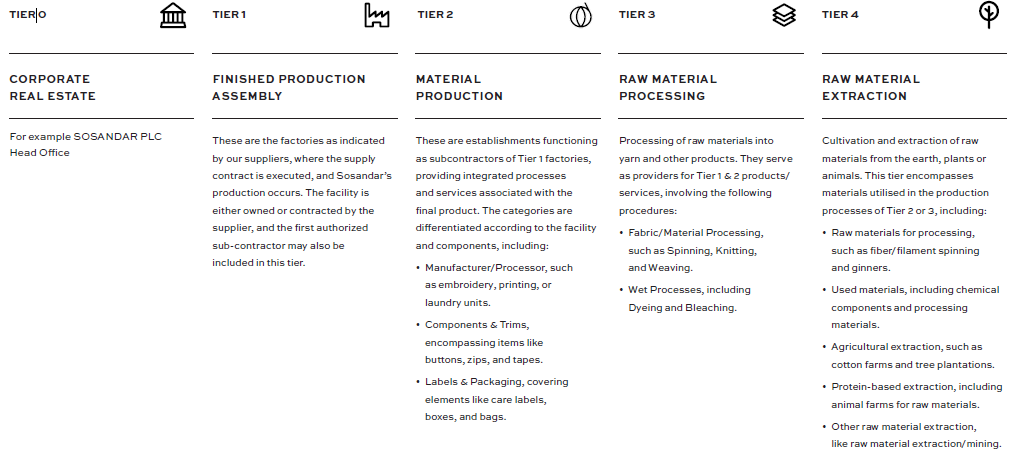
Sosandar defines its tiers as follows:
Sosandar Employees & Training
Our employees have access to, and sign to comply with, a staff handbook, which details various policies supporting our commitment to responsible business. It protects the rights of both our direct and indirect employees and promotes an ethical supply chain. These include, but are not limited to our Code of Conduct, Grievance Procedure, Whistleblowing policy and our Anti-Bribery policy.
We ensure that the required legal checks are completed for all employees who join Sosandar, and we only work with recruitment agencies who mirror our commitment to onboarding people responsibly.
Next Steps – 2025/26
During financial year 2025/26, we plan to take the following key steps to further strengthen our approach to combatting the risk of modern slavery and trafficking in our supply chains:
- Ongoing enhancement in our approach to combatting modern slavery by adopting the guidance and of the Ethical Trading Initiative (ETI), ensuring our priorities and strategies remain fit for purpose.
- We will continue to explore opportunities of working with external parties and outside agencies to ensure the business remains compliant with all relevant local and international regulations. In addition, we will utilise the guidance outlined by the ETI to prepare the business for potential future ETI membership.
- Ongoing monitoring and improvement of our audit verification and supplier management processes, supported by the implementation of a platform solution in partnership with one of our key supply chain compliance providers. This system modernises the way we capture and manage supply chain data, supporting improved traceability and transparency beyond Tier 1 factories. It enables the collection and verification of critical supplier information related to social, environmental, and ethical compliance, ensuring all relevant documentation is in place. This not only reinforces our compliance standards, but also drives greater efficiency and visibility across our operations.
- Ensuring that all key personnel within the wider business receive up-to-date training on responsible and sustainable sourcing, including risks of modern slavery and country-specific challenges, supported by our extensive business policies.
- Continuous improvement of our external communication with suppliers to ensure all parties remain aligned with expectations and key business KPIs.
- 2025/26 will see a further focus strategic key partnerships across the supply base to focus on key territories where we can monitor and ensure best practices. At the same time, we will explore sourcing opportunities in new territories to reduce overexposure in any single region and to mitigate risks associated with geopolitical instability. This will enable us to maintain a well-balanced and resilient supply base in which both we and our customers can have full confidence.
This statement was approved by the Board of Directors in July 2025 and is made regarding section 54(1) of the Modern Slavery Act 2015 and constitutes our ongoing commitment to ending slavery and human trafficking for good.
Signed for, and on behalf of, the Board:
Julie Lavington and Ali Hall
Co-CEOs
Date: 26/08/2025